

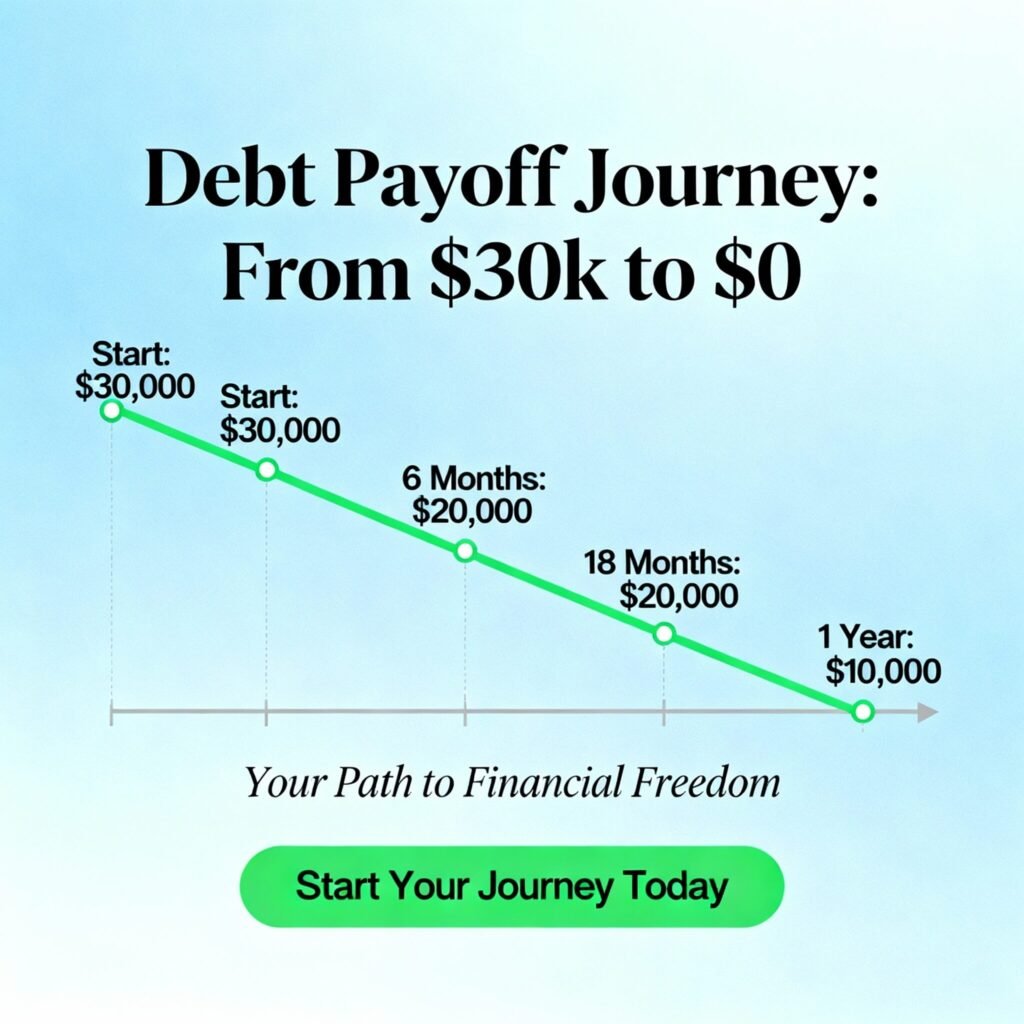
In January 2024, I was $30,000 in debt and barely making minimum payments.
My monthly income? $4,200 after taxes. My minimum debt payments? $1,100/month. I was living paycheck to paycheck, stressed, and convinced I’d be in debt forever.
Fast forward to June 2025, and I’m 100% debt-free.
This isn’t a “get rich quick” scheme. This is my real story—complete with spreadsheets, monthly breakdowns, mistakes I made, and the exact strategy you can copy.
The Breaking Point
In December 2023, I tried to buy Christmas gifts and my credit card was declined. That was my rock bottom.
I spent the first week of January 2024 doing a complete “financial audit”:
✓ Pulled all credit reports
✓ Listed every debt with interest rates
✓ Calculated total monthly interest: $420 (going nowhere!)
✓ Reviewed 6 months of bank statements
The results were horrifying. I was hemorrhaging $950/month on non-essentials:
- $600/month on restaurants and takeout
- $200/month on unused subscriptions
- $150/month on coffee shops
My Complete Debt Breakdown
Here’s what I was facing in January 2024:
| Debt Type | Balance | Interest Rate | Monthly Interest |
|---|---|---|---|
| Credit Card 1 (Chase) | $8,500 | 24.99% | $177 |
| Credit Card 2 (Capital One) | $6,200 | 21.49% | $111 |
| Credit Card 3 (Discover) | $3,300 | 18.99% | $52 |
| Student Loan | $9,000 | 6.8% | $51 |
| Personal Loan | $3,000 | 11.5% | $29 |
| TOTAL | $30,000 | 17.2% avg | $420/month |
That’s $5,040 per year in interest alone.
Choosing My Strategy: Avalanche vs. Snowball
I researched every debt payoff method and chose the Debt Avalanche (paying highest interest rate first).sheetgo+1
Why Avalanche Over Snowball?
Debt Avalanche: Pay off highest interest rate first
Result: Saved $2,400 in interest, finished 4 months faster
Debt Snowball: Pay off smallest balance first
Result: Quick psychological wins, but costs more long-term
My choice: Avalanche. I’m motivated by math and maximizing savings.tiller+1
Consider Snowball if you:
- Need quick wins for motivation
- Have many small debts under $1,000
- Struggle with staying disciplined
Month 1-3: The Foundation
What I Did:
Week 1-2: Setup
- Downloaded Monarch Money budgeting app ($99/year)
- Set up automatic minimum payments on all debts
- Created debt avalanche payment trackersheetgo+1
Week 3-4: Budget Overhaul
- Cut $800/month in expenses (detailed below)
- Started side hustle (freelance writing)
- Built $1,000 emergency fund first
Budget Transformation:
BEFORE (Monthly):
- Income: $4,200
- Debt payments: $1,100 (minimums only)
- Restaurants: $600 ❌
- Subscriptions: $200 ❌
- Coffee: $150 ❌
- Overspending by $400/month!
AFTER (Monthly):
- Income: $4,200 + $400 side hustle
- Debt payments: $2,000 💪
- Restaurants: $100 (80% cut)
- Subscriptions: $15 (92% cut)
- Coffee: $30 (80% cut)
- Redirected $900 extra to debt
The Tools That Actually Helped
🏆 Top 3 Budgeting Apps I Tested:
1. Monarch Money – $99/year ⭐⭐⭐⭐⭐
- Beautiful, intuitive interface
- Automatic transaction categorization
- Net worth tracking dashboard
- Best for: People who want automation
2. YNAB (You Need A Budget) – $99/year ⭐⭐⭐⭐
- Zero-based budgeting philosophy
- Forces intentional spending decisions
- Steep learning curve initially
- Best for: Hands-on budgeters
3. Rocket Money – Free to $12/month ⭐⭐⭐⭐
- Finds and cancels subscriptions automatically
- Saved me $185/month in first week!
- Premium features require upgrade
- Best for: Finding hidden expenses
Month 4-9: The Grind (Where Most People Quit)
This was the hardest period. The novelty wore off. I was exhausted from saying “no” to everything.
How I Stayed Motivated:
📊 Visual Debt Tracker
Created a wall chart with $500 blocks. Colored one in each time I paid $500. Seeing visual progress was addicting.notion
👥 Accountability Partner
Texted my best friend weekly updates. She was also paying off $12,000. We celebrated small wins together.
🚫 “No Spend” Challenges
One “no spend week” per month: only groceries and gas. Saved extra $200-300 each time.
💰 Side Hustle Income
- Freelance writing: $400-600/month
- Facebook Marketplace (sold unused items): $200
- Dog walking on Rover: $200/month
Progress Tracker:
Month 4: $25,800 → $24,000 (paid $1,800)
Month 5: $24,000 → $22,100 (paid $1,900)
Month 6: $22,100 → $20,100 (paid $2,000) ✅ Crossed $20K!
Month 7: $20,100 → $18,250 (paid $1,850)
Month 8: $18,250 → $16,150 (paid $2,100)
Month 9: $16,150 → $14,200 (paid $1,950) ✅ Halfway there!
Month 10-15: The Momentum Phase
By month 10, something magical happened: paying off debt became addicting.
Game-Changing Moments:
🎉 First Credit Card Paid Off (Month 10)
Eliminated Chase card ($8,500 at 24.99% interest). Freed up $255/month minimum payment and redirected it to the next highest-interest card. This is the “avalanche effect” in action !spreadsheetdaddy+1
💵 Income Increase
- Work raise: +$300/month
- Side hustle growth: +$800/month
- Total extra income: $1,100/month
💸 Tax Refund Windfall (Month 14)
Received $2,400 tax refund in April. Put 100% toward debt instead of spending it. Knocked out 2 full months of payments in one day!
Acceleration Results:
| Month | Payment | Balance Left | Milestone |
|---|---|---|---|
| 10 | $2,300 | $11,900 | 60% complete! |
| 11 | $2,200 | $9,700 | Under $10K! |
| 12 | $2,500 | $7,200 | 2nd card paid off! |
| 13 | $2,100 | $5,100 | Under $5K! |
| 14 | $4,600 | $500 | Tax refund used! |
Month 16-18: The Final Push
With only $7,000 left across 2 debts, I went all-in with aggressive tactics.
Extreme Measures:
🚗 Downsized My Car
Sold my car for $8,000, bought reliable used one for $4,500. Put $3,500 toward debt.
⏰ Picked Up Overtime
Worked 5 extra hours/week at my job. Added $400/month.
📱 Cut Remaining Luxuries
- Switched to cheaper phone plan: -$60/month
- Canceled cable, kept Netflix only: -$80/month
The Final Countdown:
Month 16: $7,000 → $3,200 (paid $3,800 - car money!)
Month 17: $3,200 → $600 (paid $2,600)
Month 18: $600 → $0 (paid $600) ✅ DEBT FREE!
June 15, 2025: I made my final debt payment.
The Real Numbers: What It Cost Me
Total Investment:
| Category | 18-Month Total |
|---|---|
| Debt principal | $30,000 |
| Interest paid | $2,800 |
| Budgeting app | $99 |
| TOTAL PAID | $32,899 |
If I’d Only Made Minimums:
| Scenario | Time | Interest | Total Paid |
|---|---|---|---|
| Aggressive payoff | 18 months | $2,800 | $32,899 |
| Minimum payments | 8+ years | $14,200 | $44,200 |
| SAVINGS | 6.5 years | $11,301 | $11,301 |
By being aggressive, I saved $11,301 and 6.5 years of my life.
What Worked (And What Didn’t)
✅ Strategies That Crushed It:
1. Debt Avalanche Method
Saved $2,400 vs. snowball, finished 4 months faster.tiller+1
2. Automatic Payments
Never missed a payment, avoided $35 late fees, built credit score from 620 → 720.
3. Side Hustle Income
Added $800/month average, accelerated payoff by 6 months.
4. Visual Tracking
Wall chart and spreadsheet kept me motivated daily.notion
5. “No Spend” Challenges
Saved $200-300 each time, broke bad spending habits.
❌ Mistakes I Made:
1. Cutting Too Much Too Fast
Month 1, I eliminated ALL entertainment. Burned out by week 3. Lesson: Budget $50/month for fun.
2. No Emergency Fund First
Car emergency in month 5 ($400) forced me back onto credit card. Lesson: Build $1,000 fund before aggressive payoff.
3. Comparing to Others
Saw people paying off debt faster online, felt inadequate. Lesson: Focus on YOUR progress.
4. Skipping the Budgeting App
Tried manual spreadsheets first, gave up after 2 weeks. Lesson: Invest in good tools ($99/year is worth it).
Your Step-by-Step Action Plan
Phase 1: Setup (Week 1-2)
Day 1-3: Financial Audit
- Pull all three credit reports (free at AnnualCreditReport.com)
- List every debt: balance, interest rate, minimum payment
- Calculate total monthly interest cost
- Review 3 months of bank statements
Day 4-7: Choose Your Method
- Debt Avalanche = saves most money (recommended)spreadsheetdaddy+1
- Debt Snowball = quick psychological wins
Day 8-14: Build Systems
- Download budgeting app (Monarch Money or YNAB)
- Connect all accounts
- Set up automatic minimum paymentssheetgo
- Open separate savings for emergency fund
Phase 2: Optimize Budget (Month 1-2)
Find $500-1,000/month to cut:
💡 Quick Wins:
- Cook at home 6 days/week: Save $400-600
- Cancel unused subscriptions: Save $100-200
- Make coffee at home: Save $100-150
- Negotiate phone/internet: Save $30-60
- Shop insurance competitors: Save $20-50
Phase 3: Boost Income (Month 2-3)
Add $300-800/month:
- Freelance on Upwork/Fiverr: $300-600/month
- Sell unused items: $200-500 (one-time)
- Gig work (Uber, DoorDash): $400-800/month
- Overtime at current job: $200-500/month
Phase 4: Execute (Month 3-18)
Monthly Routine:
- ✅ Pay all minimums automatically
- ✅ Put extra $800-2,000 toward highest-interest debt
- ✅ Track progress weekly
- ✅ Do one “no spend week” per month
- ✅ Direct all windfalls to debt
Frequently Asked Questions
Q: Should I pay off debt or save for emergency fund first?
A: Save $1,000 emergency fund first, THEN aggressively pay off debt. Otherwise one unexpected expense forces you back into debt.notion
Q: Debt avalanche or debt snowball?
A: Avalanche (highest interest first) saves more money. Snowball (smallest balance first) provides faster wins. I recommend avalanche for most people.tiller+1
Q: Should I use savings to pay off debt?
A: Keep 3-6 months expenses in emergency fund, use rest to pay off high-interest debt (over 10% APR). Don’t drain savings completely.
Q: What budgeting app should I use?
A: Monarch Money for automation, YNAB for hands-on control, Rocket Money for finding subscriptions.
Q: Can I really pay off $30,000 in 18 months on $50K salary?
A: Yes. I made $50,400/year. Key: Cut expenses $800/month + side hustle $800/month = $1,600 extra for debt.
Final Thoughts
18 months of intense focus gave me:
- $0 debt
- $10,000 emergency fund
- 720 credit score
- $1,100/month cash flow increase
- Peace of mind: Priceless
The path to debt freedom isn’t complicated:
- Spend less than you earn
- Put every extra dollar toward debt
- Increase income where possible
- Stay consistent for 12-24 months
Don’t wait. Start today with a financial audit. Your future self will thank you.


![Before and after transformation: 210 lbs to 170 lbs [ gym , los , workout]](https://heykaldesigns.com/wp-content/uploads/2025/11/weight_loss_transformation-150x150.jpg)